
Richland County Property Tax Record Fields
The county Treasurer links a public tax and parcel portal. It shows bill, receipt, value and balance details. The Real Property Lister keeps the owner of record, mailing and situs addresses, and the parcel number. That office also holds the legal description, acreage and district fields. Assessment rolls and Board of Review proceedings stay local municipal matters. Read each figure in context. A value amount, a bill amount and the amount still due answer three different questions about the same parcel.
| Field | What It Shows | Where It Is Held |
|---|---|---|
| Owner and address | Roll owner, tax mailing address and property address | Real Property Lister / tax portal |
| Parcel description | Parcel number, legal description, acres and districts | Lister and GIS |
| Assessment and value | Assessment and fair market value fields | Municipal assessment roll / county portal |
| Tax bill | Charges, installments and billed amounts | Municipality and Treasurer |
| Receipt and balance | Recorded payments or remaining balance inquiry | Treasurer portal / treasurer |
| Lottery credit claim | Portal action named by the Treasurer | Tax portal; follow its current directions |
Wisconsin's municipal tax structure means the collector on a single bill depends on the installment. Keep the tax year and the municipality in view whenever you read the roll or the bill.
Finding a Richland County Tax Bill
Start with the address or parcel number to pull up the county tax record. Compare the bill year and the municipality before trusting any payment status. The Treasurer's page explains the bill, receipt, value and balance functions the service offers. The Catalis public portal uses Guest Sign In for parcel data. Field controls can shift as the county updates the service. A missed search is a cue to check spelling. It is also a reason to ask the Treasurer directly. Do not assume a property has no tax file.
- Search by the situs/property address or parcel number.
- Check the owner, municipality and mailing address against the parcel in question.
- Open the tax bill for the proper year and identify each installment.
- Review receipts and the balance inquiry to see whether payments posted.
- Contact the municipal or county collector listed for that installment if the record is unclear.
- Assessed value
- The local roll's value used in the tax process; it is not automatically the sale price.
- Levy
- The amount a taxing body raises, shared across taxable property under state rules.
- Installment
- A scheduled part of a tax bill, collected by the responsible treasurer.
- Delinquency
- An unpaid tax balance subject to the county's stated interest and collection rules.
The Richland County Treasurer tax page identifies bill and payment lookup functions.
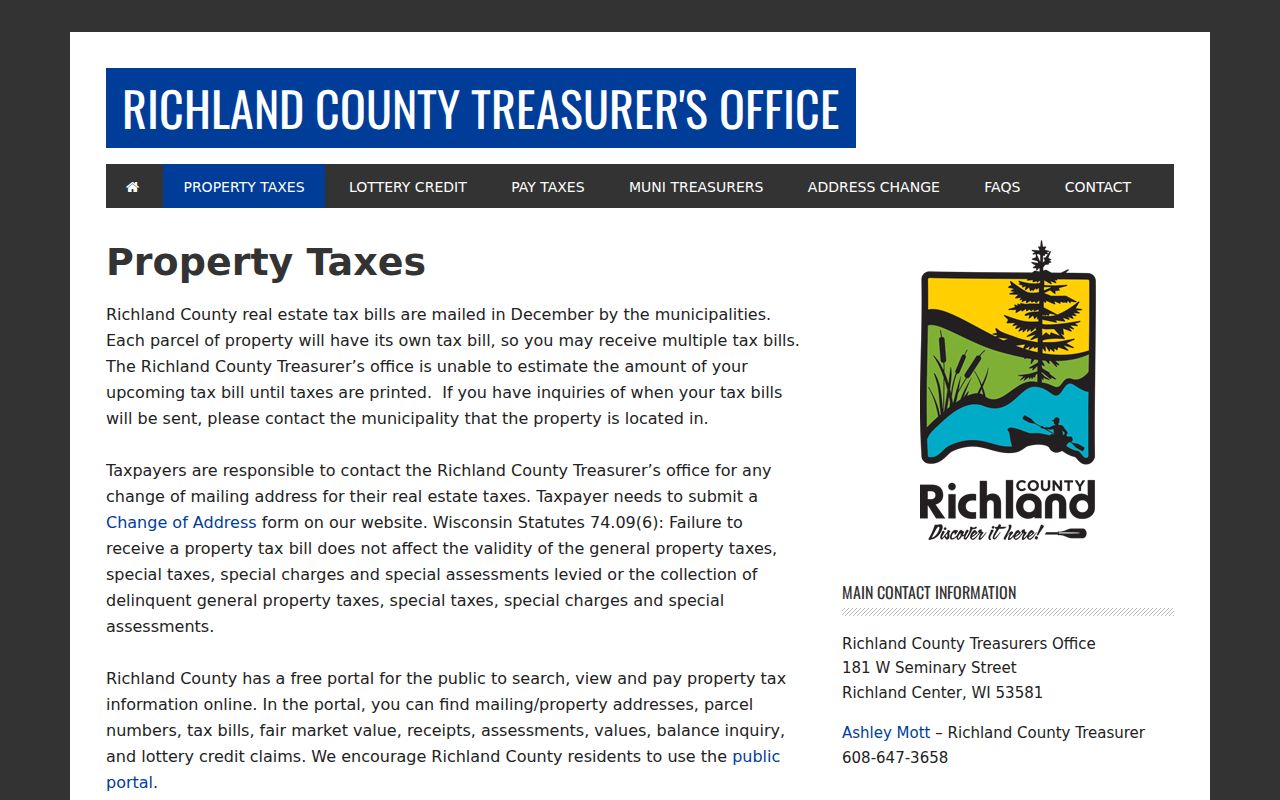
Use the screen as a route to the record. Keep the bill year and parcel number with your notes.
Richland County December Bills
Municipalities mail real-estate tax bills in December. The first installment generally goes to the local municipal treasurer. The county treasurer collects the second installment, postponed taxes and delinquent balances. The Treasurer lists its office at 181 West Seminary Street, Suite 2, Richland Center, WI 53581, at 608-647-3658 and treasurer@co.richland.wi.us, with reported public hours of Monday through Friday, 8:30 a.m. to 4:30 p.m.
Each parcel gets its own bill. A missing paper notice does not cancel the tax. Confirm the municipal collector and parcel details on the bill or the county tax page before sending payment, then keep a receipt or online confirmation with the tax year and parcel number so a later balance inquiry can be reconciled.
The installment split matters when a payment appears missing. The first installment generally goes to the city, village or town treasurer, while the county Treasurer takes the second installment, postponed payments and delinquency. A receipt from one collector may not answer the balance shown for the other installment. Check the year, parcel and collection office on the bill. Then contact that office with the payment date and confirmation number.
Richland County's October Roll Cutoff
The county's system states that its upcoming tax cycle reflects real-estate transfers recorded through October 15, 2025. An exception applies to some parcel splits. A deed recorded after that cutoff may not change the owner name. The upcoming tax bill can keep the old name. That timing gap does not mean the Register of Deeds skipped the sale. Recording the deed and updating the tax roll are separate steps.
A buyer and a bill may show different names. Compare the deed recording date with the tax-roll date. The roll gives the administrative owner-of-record view at its cutoff. The newest deed reflects the more current recorded transfer. Neither document alone is a complete title review.
Richland County Split Parcels
In Henrietta, Ithaca, Marshall and Richland, split parcels are not split in the tax system until the next year. The county says so plainly. A CSM can define a new lot in the deed records. But the coming tax roll still reflects the older parcel arrangement.
That timing can confuse things. A tax card, a GIS drawing and a newly recorded instrument may tell three slightly different stories.
Check the GIS CSM and CSM History layers. Then get the recorded CSM or plat from the Register of Deeds. Keep the original parcel number and the new legal description in separate notes. For current-year split-bill questions, ask the Lister. The county names Julie Lins at 608-647-3334 and, for qualifying situations, Bruce Gardiner at 608-732-4481.
Richland County Delinquent Tax Rules
The county Treasurer states that delinquent real-estate taxes become due in full. Under the county FAQ, unpaid principal accrues 1.0% monthly interest back to February 1. Two or more delinquent years can make a property subject to tax deed. These are material collection rules. So check the live Treasurer page for the parcel and year rather than an old third-party summary.
Tax-deed status is not proof that a new owner holds marketable title. Review the Treasurer's file, the recorded deed index and any WCCA case or related instrument. The county publishes no confirmed public tax-sale calendar. Ask the Treasurer about current notices and next steps.
Wisconsin Value and Tax Math
Wisconsin's Property Assessment Manual sets a local goal of assessing at 100% of market value. That goal is measured at the municipality level. The assessment/sales ratio compares one parcel's assessed value with its sale price. DOR's aggregate ratios work differently. They compare a municipality's total assessed value against its equalized value. A single parcel can sit far from a recent sale price. That gap alone does not prove an error.
A Richland County tax bill also reflects the levy. It reflects the parcel's share of the local tax base too. A bill can rise for three reasons. The assessment climbed, the levy grew, or the parcel's slice of the tax base shifted. The assessment record is where to inspect parcel value. The bill itself explains the charges for that tax year. The Wisconsin assessment manual covers ratios in depth. The county portal exposes fair market and assessment fields for each parcel.
Open Book lets a property owner review the local assessment record. That review comes before filing a Board of Review objection. Bring the meeting a careful comparison. Match the property card's land, building, acreage and condition facts against the parcel itself. A clerical error in an improvement description is not the same as a dispute over market value. Name the exact point of contention before assembling evidence. The Wisconsin DOR Open Book and Board of Review calendar lists each municipality's assessment-review dates.
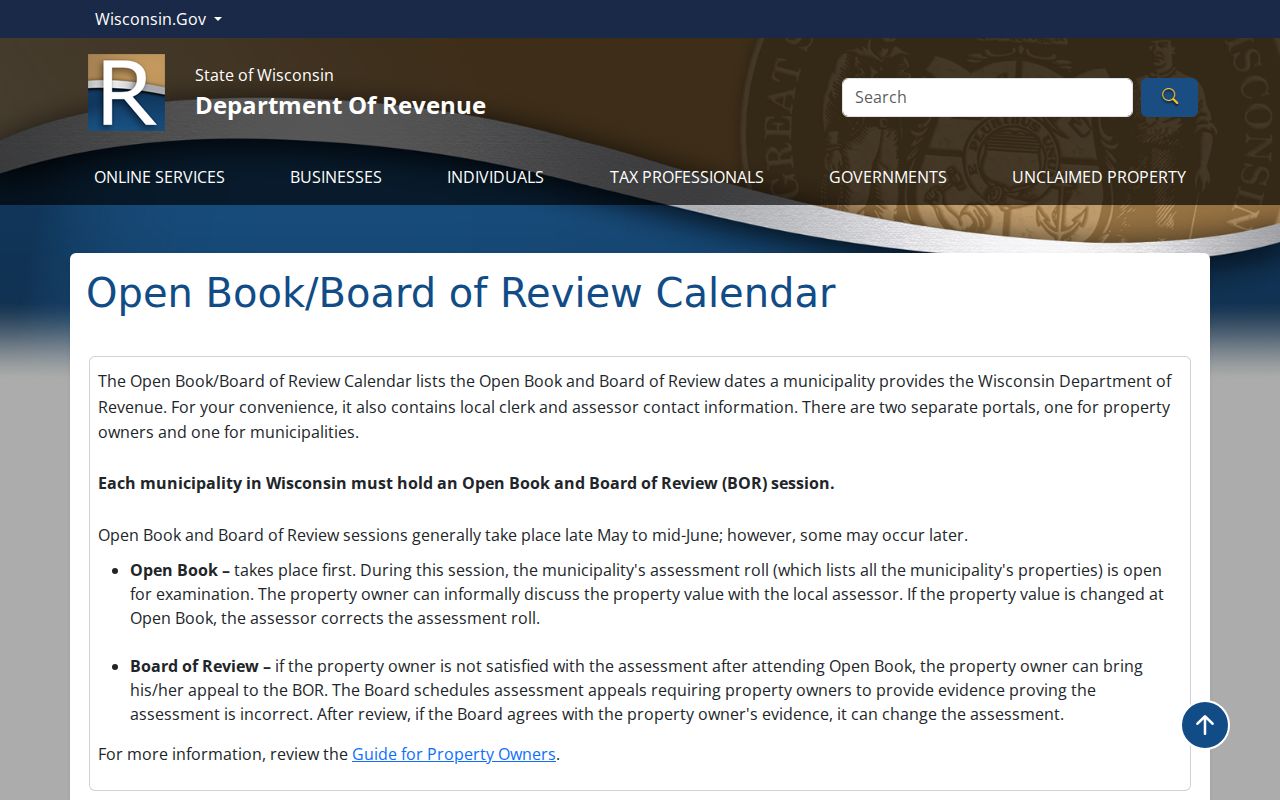
The DOR calendar helps identify the local review dates, which vary by municipality.
Appealing a Richland County Assessment
Open Book always comes before a Board of Review hearing. The Wisconsin Department of Revenue calendar normally shows local sessions. These run from late May through mid-June. Check your exact town, village or city entry for the current year. The taxpayer must give written or oral notice of intent. This must happen at least 48 hours before the first BOR meeting. The PA-115A form is then filed within the first two hours of that meeting.
Good evidence includes the assessment notice, the property-record-card facts, comparable sales and photographs showing condition. DOR publishes the objection form and the hearing rules. A waived BOR hearing can trigger short circuit-court timelines. Follow the current state directions for the appeal route you choose. The PA-115A and 48-hour notice page sets out each objection step and deadline.
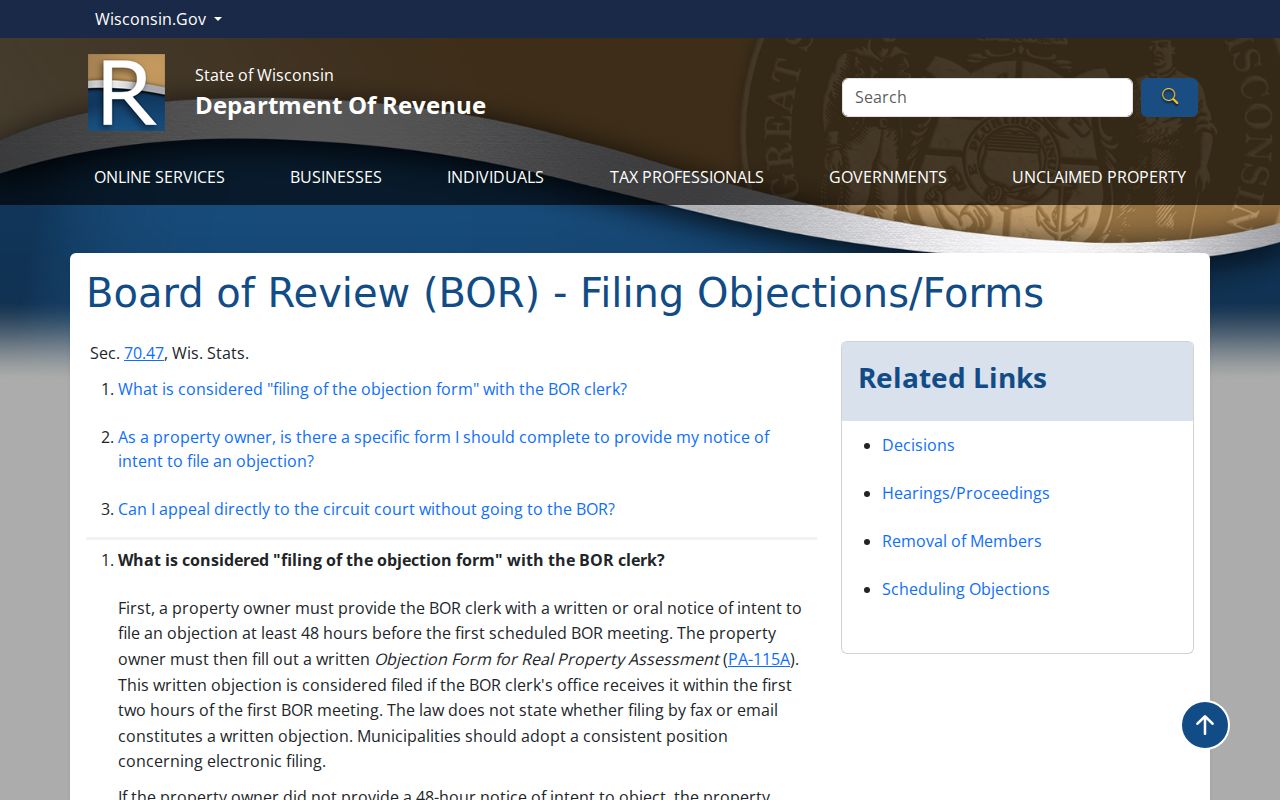
Notice is early. File the intent notice at least 48 hours before the first Board of Review meeting and meet the PA-115A filing window stated by DOR.
Richland County Tax Record Requests
When a bill, payment or assessment file is missing from the portal, contact the proper custodian with the parcel number, property address and tax year. The County Treasurer handles bills, receipts, delinquency and tax-deed questions. The Real Property Lister keeps parcel owner and transfer fields. Assessment-roll access and Board of Review records stay tied to the local municipality.
Wisconsin Public Records Law, Wis. Stat. §§19.31–19.39, governs access to existing public records. A custodian need not build a new analysis. Copy fees generally track actual, necessary and direct costs. Request inspection first if a certified copy is unnecessary. For deed ownership questions, use the Register of Deeds index and instrument record instead.
A focused Richland County request should name the parcel number, tax year, and the specific bill, receipt, assessment card, payment posting or Board of Review record sought. Comparing years? List each year separately. That lets the custodian locate the right account history. Ask which office maintains the record before sending sensitive payment details, and confirm the current copy or inspection process with that office directly.