
How Richland County Property Records Work
Land information in Richland County lives in separate systems. The Register of Deeds records instruments. The Real Property Lister turns transfer papers into parcel and owner fields. Municipal assessors keep local assessment rolls, the Treasurer collects taxes, and the public GIS maps parcels. Your starting clue shapes the path. An address places a parcel quickly in GIS or the public tax portal. An owner name can return several parcels. A parcel number is the cleanest bridge between the tax card, map and deed search.
Keep every result tied to its source. Pull the parcel number and legal description from the tax card, then compare the latest deed against the map layers. The county tax portal is an administrative record, not a same-day title index. A deed names who signed a recorded transfer, while GIS locates the land. No single record confirms every lien, boundary or interest.
- Find the likely parcel by its physical address in the county tax portal or GIS viewer.
- Save its parcel number, municipality, owner field, situs address and mailing address.
- Use the parcel and owner names to locate the latest recorded conveyance.
- Compare tax values and bill status with the map's parcel and CSM layers.
- Ask the record custodian for an in-person, mailed or certified copy when the online record is incomplete.
Keep a short source log as you move between systems. Note the office or portal, date viewed, parcel number, tax year and instrument number. That habit keeps a later search from quietly overwriting an earlier result. A deed may describe the land more precisely than a street address. GIS and the tax portal hang on a parcel number instead. After a recent split those identifiers can disagree. Compare the recorded CSM. Then ask the Real Property Lister which parcel structure governs the current roll.
For a document request, describe the record and the property as precisely as you can. Wisconsin Public Records Law, Wis. Stat. §§19.31–19.39, opens access to existing records held by state and local custodians. Access is subject to statutory limits and custodian review. The law does not force an office to create a new ownership report or legal conclusion. Request inspection or a copy of the specific deed, assessment card, tax receipt, map or permit file.
Offices Behind Richland County Records
These offices form a handoff, not one combined database. Richland County property records start with your question, an instrument or a parcel, and then move to the office that holds it. Town and village assessors run local assessment. County staff maintain parcel ownership data and collect some tax balances.
Register of Deeds
181 W. Seminary Street, Room 3
Richland Center, WI 53581
608-647-3011
Real Property Lister
Richland County Courthouse
Richland Center, WI
608-647-3334
County Treasurer
181 W. Seminary Street, Suite 2
Richland Center, WI 53581
608-647-3658
Land Information Office
Richland County, Wisconsin
GIS and survey resources
County directory
Think of the parcel trail as a handoff. The Register of Deeds records the instrument. The Real Property Lister updates ownership and parcel fields. GIS maps parcel and survey context, and the Treasurer tracks bills and balances. A local assessor's roll and the Board of Review stay municipal. When a recent sale has not reached the tax portal, use the recording date and the October 15 roll cutoff. That pairing picks the right office for the next question.
Richland County Property Record Types
The record set depends on the question. A transfer, a tax bill, a boundary change and a permit each sit with a different custodian. Richland County property records work best when you compare them by parcel number and legal description.
| Record | What It Documents | Custodian | Access Route |
|---|---|---|---|
| Deed and mortgage | Parties, conveyance, financing or lien filing | Register of Deeds | Tapestry EON, Laredo, counter, copy order |
| Parcel ownership | Owner, mailing and situs address, legal description, acreage, districts | Real Property Lister | Catalis public portal or Lister request |
| Tax bill and receipt | Installments, payment, assessed and fair market fields, balance | Municipal and County Treasurer | Tax portal or treasurer |
| Parcel and CSM map | Parcel lines, parcel IDs, survey-map lots and history | GIS / Land Information | Public viewer, print map or data request |
| Permit and zoning file | Allowed work, review, land use or boundary application | City, town or village | Local office or records request |
A deed index is the tool for recorded transfers. Tax and map records explain the parcel around that instrument. Detailed transfer steps sit on the Richland County deed records page, while the bill and appeal trail belongs with property tax records.
Richland County Roll Timing
Richland County's current tax system reflects transfers recorded through October 15, 2025. That covers the coming tax cycle. That date is a roll cutoff, nothing more. It does not mean a later-recorded deed is missing from the Register of Deeds. A closing after the cutoff can leave the seller's name on the next bill or public parcel display. Even so, the new deed is recorded.
Splits follow a second timing rule. In Henrietta, Ithaca, Marshall and Richland, the county treats split parcels as separated only the next year. A new owner may see a parent parcel on the tax roll. Meanwhile, the GIS CSM History or a recorded survey map already shows the change. Keep the deed date, recording reference and tax-roll date distinct when comparing results.
Check the record date. For a recent purchase, compare the tax owner field with the newest Register of Deeds instrument before relying on the bill name.
Richland County Parcel GIS Layers
The county's public GIS service goes far beyond parcel outlines. Layers cover address points, parcel numbers, roads, streams, lakes, municipalities, sections and quarter-quarters. CSMs, CSM lots and CSM history appear too. Wards, supervisory districts and the Richland Center extraterritorial boundary are included as well. Viewing these together shows whether an address falls in a town, village or city. It also shows whether a mapped lot was reshaped by a survey map.
The Richland County GIS viewer instructions explain how to search by site address or parcel number. They also explain the Identify tool, marked with a red exclamation point. Select one or more parcels and the detailed information opens. Some advanced functions require the Subscription Viewer, so a missing export does not mean the county has no GIS record.
The official public map service layer list displays the full set. That is why parcel lines, CSMs and municipal edges can be reviewed side by side.
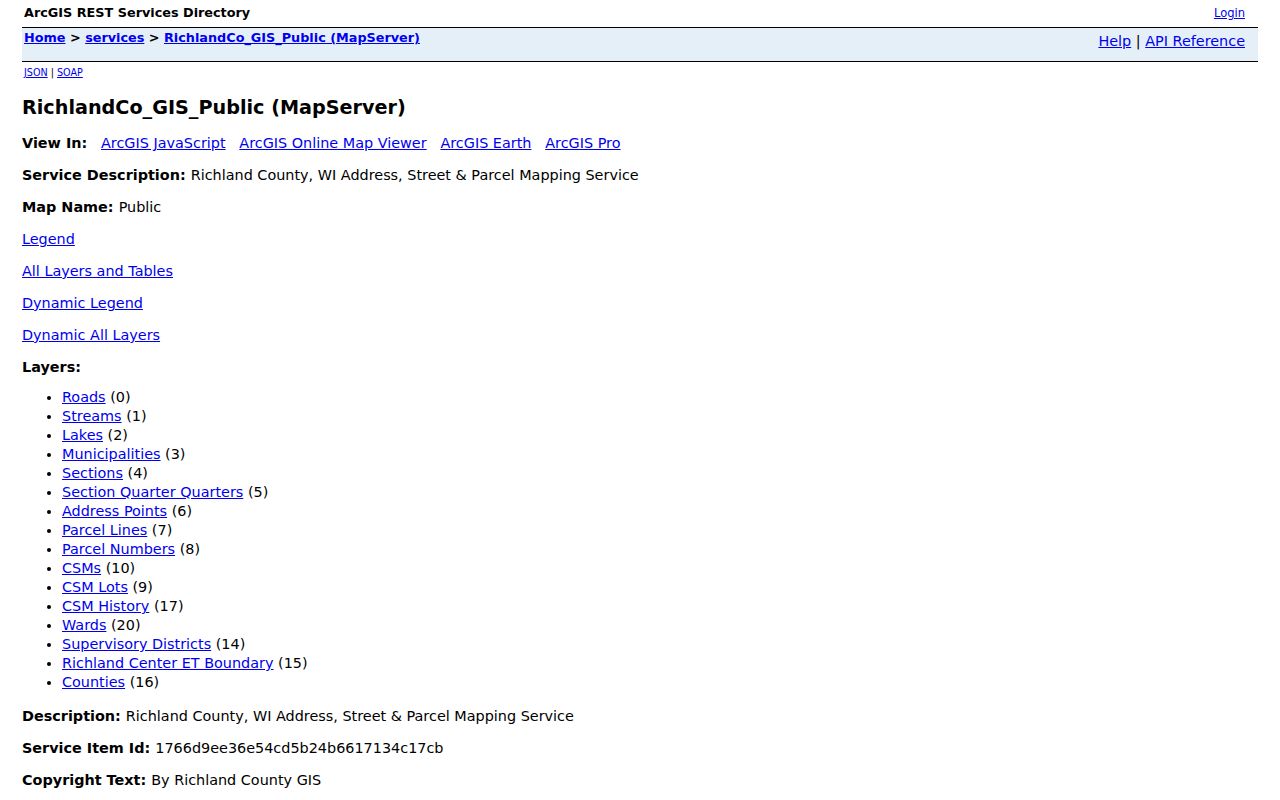
Treat the layer names as search aids. A recorded CSM, survey or legal description always controls over a visual GIS line.
Richland County Deed Index Access
The Register of Deeds repository holds warranty and quitclaim deeds. Mortgages, real-estate financing statements, federal tax liens and miscellaneous documents sit in the same archive. Tapestry EON serves occasional users. Laredo is the paid subscription for firms needing daily access. The county also sells online copies you can print or save after purchase. The office can handle counter or mail requests when an image is not online.
The county does not state an earliest online index year. Search grantor and grantee names first. Then verify the document number, recording date and legal description on the returned instrument. Never assume a portal's earliest listing marks the start of the county's record series.
The official Register of Deeds page also links a free Property Fraud Alert. It notifies a submitted name whenever matching documents are recorded.
The alert is early notice only, not a title search or a block on recording.
Richland County Tax Bills and Installments
Real-estate tax bills go out from municipal treasurers each December. Each parcel stands on its own bill. Local municipal treasurers take the first installment. The county treasurer handles the second, along with postponed amounts and delinquencies. Through the Treasurer's portal, a parcel search pulls up tax bills, receipts, balances and lottery-credit claims in one place.
Losing a bill does not erase the tax. Wisconsin Statute 74.09(6) says as much, according to the county. Unpaid principal builds interest at 1.0% per month from February 1. Two or more delinquent years can open the door to a tax deed. Anyone weighing a distressed property should weigh the Treasurer's status beside recorded instruments and court activity. A single balance screen is not proof that a transfer closed.
Wisconsin Assessment Review Route
Wisconsin aims to assess property at 100% of market value at the municipality level, yet a parcel's assessed value can still diverge from its latest sale price. The local assessment ratio is simply assessed value divided by sale price. Tax bills also hinge on the levy and the property's share of the community total, so an assessment change alone cannot explain a tax change.
Open Book comes first, then Board of Review. The Department of Revenue calendar lists local dates, often from late May into mid-June, but each town, village and city sets its own meeting. Notice of intent to object is due at least 48 hours before the first BOR meeting, and PA-115A is due within the first two hours of that meeting. Useful evidence includes the assessment notice, property-card facts, comparable sales and condition photos.
The Wisconsin DOR calendar and its PA-115A objection instructions lay out the sequence and the notice rule.
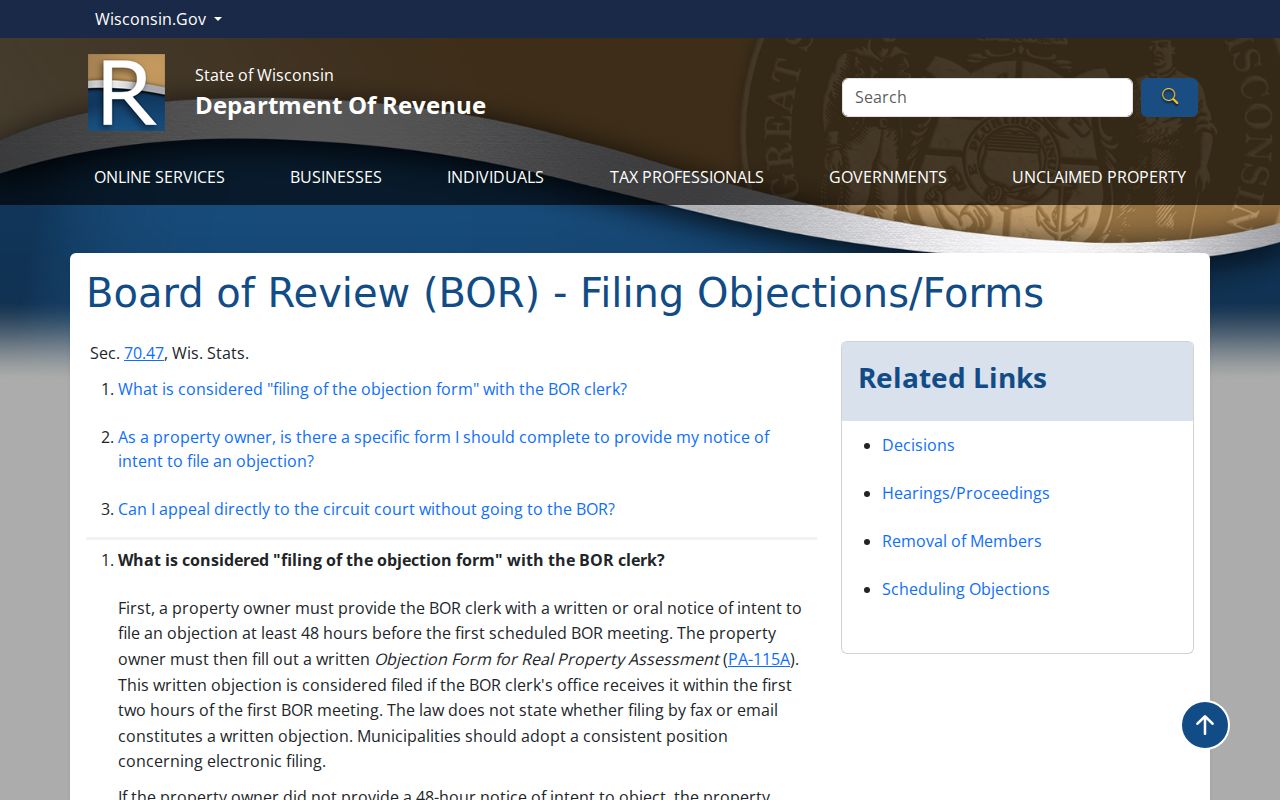
Waiving a hearing can trigger short court deadlines later. Follow the current DOR instructions for your specific route.
Richland County's 1895 Plat Book
The 1895 Plat Book holds older ownership clues for Richland County. The Wisconsin Historical Society digitized it from surveys and county records. Its 44 numbered pages map cities, villages and townships. A house-history search can gain a landowner, acreage figure, section number or old road name. These can be missing from the modern address field.
Use the atlas as a bridge, not proof of present title. Trace the historical name or parcel setting. Translate it through township and section context. Then move to the Register of Deeds and modern GIS. Richland County was created in 1842 and organized in 1850. Richland Center became the county seat in 1852, and the current courthouse dates to 1889. Research before countyhood may lead to territorial, federal land or parent-county records.
The 1895 Richland County plat-book scan offers a period view of local place names. It also shows the period's land divisions.
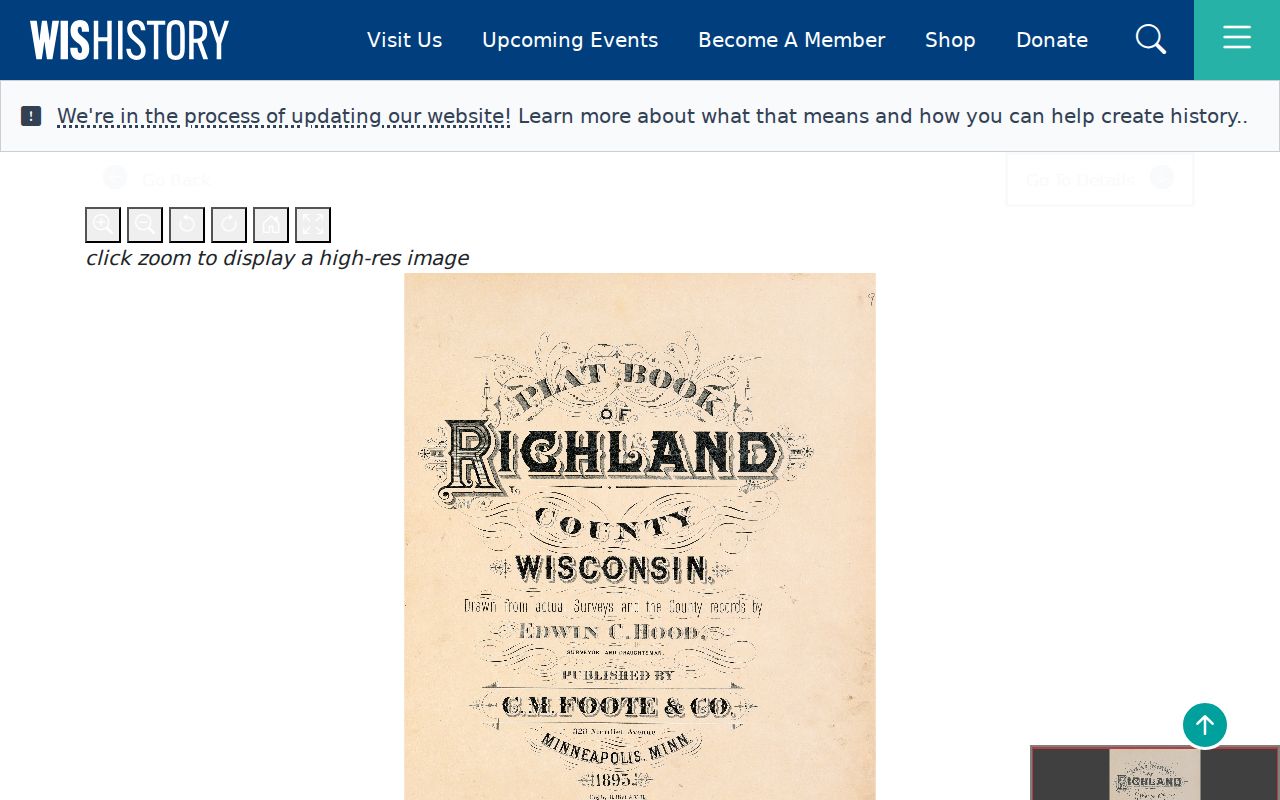
Pair any historic map clue with a deed or recorded survey before drawing a modern boundary.
Richland Center Street Clues
Old Richland Center deeds often name streets that no longer match the map. Chapter 601 of the city ordinances explains why. It applies to the Original Plat plus the Schoolcraft and Haseltine's Addition plats. Hascal Street became Park Street. In Schoolcraft, the east-west streets north of Union Street are numbered. Haseltine's Addition keeps Lincoln and Ward. That crosswalk makes an old deed or city directory readable against the current plat.
Search the historic and modern labels together. Then check the city ordinance, the 1895 atlas, and the county parcel number. A Richland Center mailing address proves little about boundaries. Its postal label can sit outside the incorporated edge. GIS municipality and ET Boundary layers help here. They show whether an address falls inside Richland Center or in a town.
Old block descriptions follow a pattern too. Schoolcraft's numbered east-west streets pair with the Original Plat's north-south names. An ordinance may have renamed them, though. Haseltine's Addition preserves Lincoln and Ward, including the former South Walnut name. Those clues link a deed or obituary address to today's map. A familiar street label alone never proves two parcels are identical.
Richland County Records Beyond Tax
A property question in Richland County can spill into court and estate files. Wisconsin Circuit Court Access lists parties, dates, filings, and docket events for public county cases. The underlying documents are another matter. Those usually require the Clerk of Circuit Court. Foreclosure, quiet-title, easement, and probate matters run through these files. A deed index rarely tells the whole story.
For a deceased owner, search probate under the exact name. Then check the deed index for an estate, trustee, or personal-representative transfer. Vital records follow their own rules. The county Register of Deeds and Wisconsin DHS issue them, subject to eligibility limits. Genealogy indexes and obituary collections each cover separate date ranges. Request only the file that fits your question. Wisconsin's Public Records Law covers an existing public record held by the proper custodian.
The county's online records sit beside courthouse files. Municipal permit offices and library or history holdings fill other gaps. A failed portal search is not the end. Ask the custodian or the library about the offline path. Do not assume the event never occurred.
Wisconsin Circuit Court Access helps place a foreclosure, probate, or title dispute in sequence. A case number plus docket events gives the timeline. It is a case-finding tool only. The county Clerk of Circuit Court holds the filings. Register in Probate can explain access to a probate file. Cross-check any judgment, lis pendens, or sheriff's deed against the Register of Deeds record. Court records and land records are separate.
Limits of Richland County Property Records
The owner field on a tax bill names the owner of record in the assessment system. It does not name the occupant. A mailing address can differ from the situs address. A late deed can post after the roll cutoff. The legal owner may be a trust, an estate, or a business entity. A GIS polygon is not a survey. A deed records one instrument. A full title review also checks releases, easements, and other interests.
Use Richland County property records for lawful research, purchase due diligence, tax review, civic questions, and house history. Wisconsin's Safe at Home program and court confidentiality rules can shield some address information. A public record is not a license to publish a private directory or target a person.
Use records with care. Verify important facts with the office that holds the record. Do not use property data to stalk, threaten or harm anyone, and seek a title professional or surveyor when legal rights or a boundary are at stake.